Wednesday, 24 January 2024

Houppelande planning, updated pattern


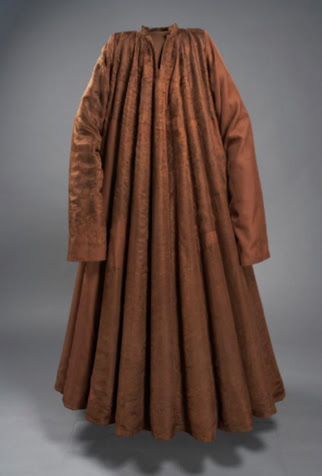
My previous Houppelandes pattens, while based on the Extant John of Gorlizt Houppelande were modified for wider width fabrics. The original had 19 trapezoid panels, 15 at 22.5cm wide and 4 at 33cm. See this pdf from Charles de Bourbon- Translated article on the Prague Houppelande  or visuals on this pinterest board Early Houppelande Project

The front diagram 

Whereas my pattern had 16 panels all at 15" (38cm) wide. Which resulted in a very similar amount of fabric used, and hem circumference, but took a lot less time to construct. 

However my previous cutting pattern would have required more piecing to be achieved with the silk velvets of the time period, that would be limited to 54cm to 60cm wide. (Medieval textiles, Cloth of Gold, pg 9)

It also appears that fur plates began to be standardized and regulated by the guilds in the 13th and 14th century

"Skins of pured minever were about 5½ inches long and 1½ or 2 inches wide, and even to sew together the 120 skins usually put into a fur of minever of eight tiers involved the sewing of over 400 seams." (The English Fur Trade of the Later Middle Ages) So the standard width of a fur plate fell within the same 55cm to 60cm range as did the Velvets.

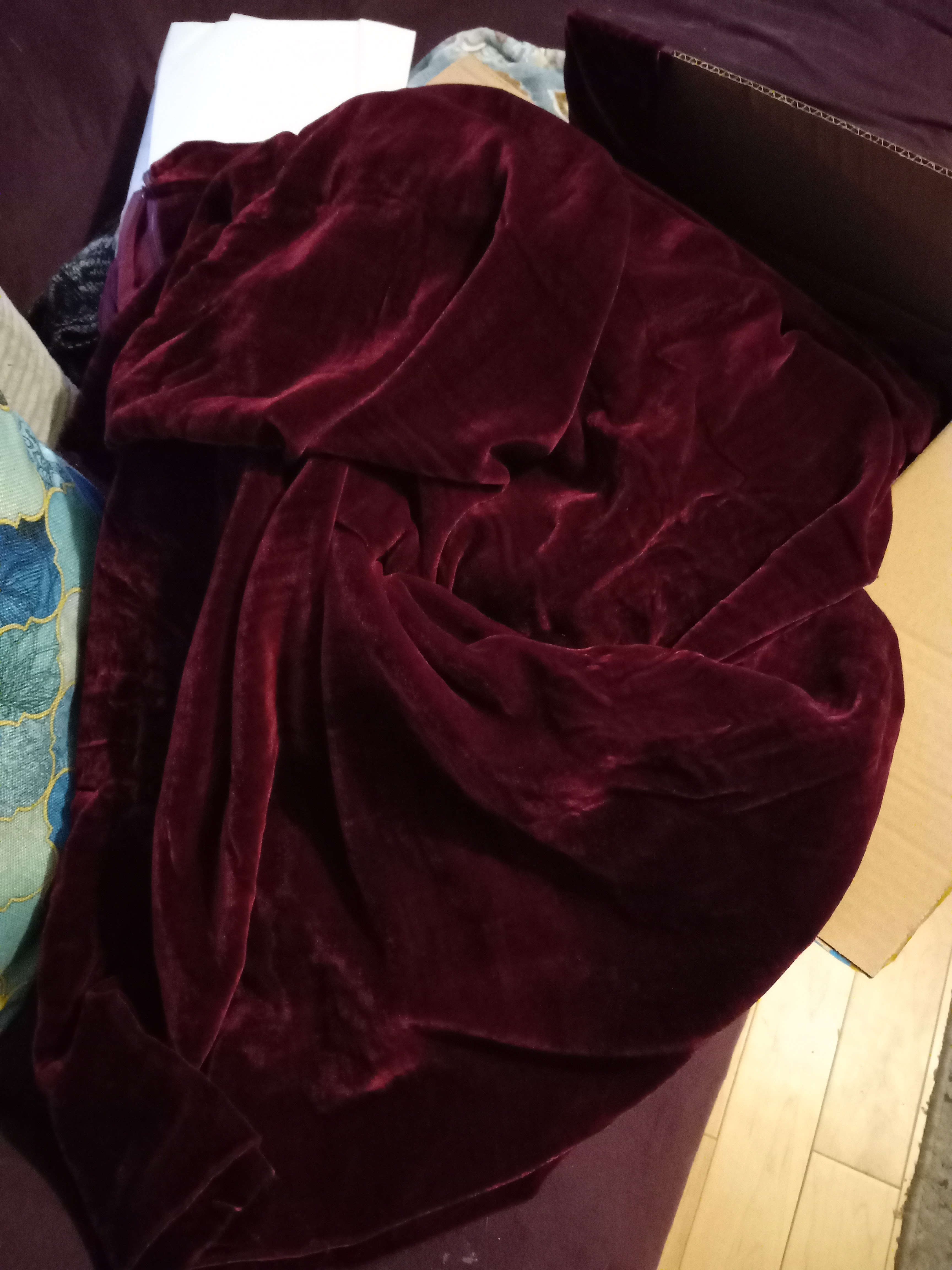
Also the silk velvet that I purchased is only 45" (115cm) wide. And so is the silk lining. 

And the ermine plates I decided to order are 55cm wide.

So clearly my previous pattern needed revision. 

And a magical thing happened.  

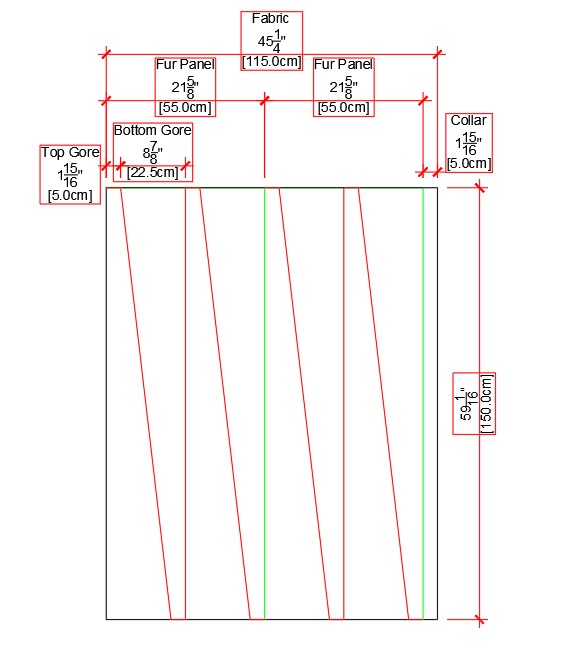
Two of the ermine plates next to each other is 110cm, only 5cm narrower than my silk. 

If I split each plate in half, and give each of my gores 5cm at the top, like the extant Houppelande, the bottom of my trapezoid panels is magical 22.5cm, also just like the extant garment. 

My new pattern is going to deviate from the Extant garment. 

-I am going to have 20 body panels all the same width of 22.5cm instead of 19 panels with 2 different widths. This is frankly for ease of construction and economic fabric use.  It also means both the front and back will have the same number of panels. The fabric nap will follow a consistent pattern, and the center front will have a seam, which makes creating an opening and placing a collar much easier. 
After laying out this pattern I can surmised how the uneven panel layout and the four pieced panels on the extant were a nessisity of needing enough fabric for the sleeves and collar, and I don’t have that limitation. 

-I also am gradually increasing the length of the panels in the back, to create a train. 
-I also am patterning 8 panels for each sleeve of increasing length to create the trailing Bombard or trumpet style sleeves 
-I will also be creating a collar that can be  buttoned, or hang open. 

These things are all to better match the prevalent images and fashion of 1410-1415.


With this layout I need 8 yards of fabric, and 14 plates of fur. 

Although I am still figuring out if the nap of the fur matters, if so I'll need extra and will have to piece. While standard fur plates are available for purchase we also see custom orders of individual skins for garments. 

"Certain furs, having been made for a particular gown, varied more considerably in size: Edward III in 1342 bought furs of squirrel made of anything from 80 to 760 skins, whereas the standard fur of eight tiers used only 120." (The English Fur Trade). 

Also in this example- "a gown made in 1531 at a total cost of £66. 16s. 4d. The eleven yards of black Lucca velvet cost £10. 7s., and 12s. was charged for the making of the gown; the 1,046 ermine skins cost £34. 17s. 4d., the 18,000 'powderings' £9 and the sum of £12 had to be paid for the work on the skins."
The 11 yards of velvet is similar to the yardage of my pattern, without bombard sleeves, which were out of fashion by then. The amount of skins ordered seems that there wasn’t many extra skins ordered. Indicating they were individually pieced for the specific garment, and presumably the nap of the fur would be the same direction.


This is an old sketch, but the concept is the same, I'm adding 4 more body panels, 2 at each side, and 2 more panels in each sleeve, following the alternating nap pattern. 

One thing to keep in mind when cutting and sewing a Houppelande is that you always want to be sewing a bias edge to a straight edge. It was what was done on the extant, and there are 2 reasons for this. 

One, the straight edge stabilizes the bias edge, minimizing the stretching that will occur.

Two, the bias to straight orientation creates a natural pleating drape effect that is prevalent in the images. 

Bonus effect of keeping the nap alternating in a pretty way. 

There are small tailoring things that will need to be adjusted during the mock up phase, such as adding the neck and arm holes, smoothing out the hem, the collar and the exact orientation of the sleeve head, so the longest back seam is at the back of the sleeves.


Tuesday, 23 January 2024

Houppelande Planning, choosing a better fabric.

In my previous post I talked about how the original fabric I had been saving for this Houppelande was just not longer viable.  So I chose a plain weave 100% silk velvet instead. 

I was inspired by this extant velvet piece for it's color, and the embroidery shows it would have been a high status color. 


So why was velvet used?  

Well at the end of the 14th century Velvet and silk production in general exploded due to several factors. 

The increasing contact with the Arabic world had grown, bringing new trade, ideas, people and skills to Europe. Italian merchants had established trade relations with the Mongol empire in the 13th century and then settled into major cities throughout western Europe.

The black plague signficantly shifted dynamic of industry, allowing people to have more disposable income and creating a high demand for luxuries and exotic products. High Fashion became a mind set for the nobility and growing merchant class, and so was very lucrative. 

In Lucca, Italy Silk artisans relocated from after the black plague. And many new regions incouraged emigration of these highly skilled weavers, offering incentives so they too could be able to profit in the demand for silk. 

The raw silk was being grown and spun more as it had become more lucrative, increasing it's availability. 
 
Velvet production was a highly specialized and time consuming process, raw silk was imported, then spun. To weave velvet needed a highly skilled worker on narrow looms, and a lot of tiny rods to create loops in the fabric, which then would be cut. A skilled worker could produce around 25cm of 60cm wide plain velvet fabric a day, and often it would take an entire year to produce 60 meters of velvet cloth of gold. 

Velvet was then often dyed in expensive dyes, creating many vibrant or deeply saturated hues. Kermes dye being the most expensive and producing bright vivid reds. 

Then velvet was then exported throughout Europe via the Italian trade merchants who were already established in the major cities, especially my focus, Paris. 

Velvet also needs special skills to handle it. It's delicate, has a strong bias stretch and fraying easily,  has a nap that is easily crushed by ironing, creases or improper storage. Mistakes in seams easily damage the fabric, and it also dosn't handle pressure well, and needs careful consideration for the lining. 

So of course Velvet became the high status fabric for those who could afford it at the end of the 14th century. 

But due to the nature of the fabric it doesn't work well for highly fitted cottes that were the it fashion. So velvet became the material used for travelers robes and the fanciest Houppelandes. 

There are many examples of velvet Houppelandes in the inventories of this time. 

The extant Houppelande of John of Gorlizt was created in 1396 out of black (originally) silk velvet for his sudden death. 

See the translated article by Charles de Bourbon, or my pinterest board for more in depth information about this. More about the details of this in later posts.

I'm choosing the velvet because of the status it would had in period, because the extant Houppelande is velvet, because there are inventory entries abound for velvet Houppelandes, because the visual representation shows draping like velvet in most of the court spaces. 

But also because of it's own particular challenges with working with it. 

One such challenge is that period velvets had a dense weave which provided a bit of structure. However modern silk velvets have a chiffon ground, which makes them lighter, gives a lot of fluidity, and bias stretch to the fabric.  So I am choosing to interline the silk velvet with a 2.8oz linen. The linen will allow for embroidery while also to help achieve the period characteristics of velvet.  

This velvet also changes colors signficantly in different lighting.  From crimson to magenta! 

Burn test confirms it is 100% silk.


I chose the color because it's one of my favorites, because it's high status when the fabric is lacking some of the other decorative elements, and because I enjoyed the deep dive into studying kermes. 

Here is a pinterest board of extant red purple extant fabrics

Some more sources too

Silk and Patronage pdf 

The last velvet merchant of Venice

Cloth and Clothing in Mediaeval Europe, Essays in memory of professor E.M. Carus-Wilson 

  • Cloth merchants' inventories in Dijion in the fourteenth and Fifteenth Centuries, Françoise Piponnier 
  • Cloth in Medieval Literature of Western Europe, Raymond van Uytven
  • The Chemistry of Red Dyestuffs in Medieval and Early Modern Europe, Judith H. Hofenk-De Graaff
  • The Medieval Scarlett and the Economics of Sartorial Splendor, John H. Munro
The development of the Florentine silk industry: a positive response to the crisis of the fourteenth century, Sergio Tognetti 2005, Journal of Medieval History

Burns, E. Jane. Sea of silk: A textile geography of women’s work in medieval French literature. Philadelphia: University of Pennsylvania Press, 2014.

Crowfoot, Elisabeth Grace, Frances Pritchard, and Kay Staniland. Textiles and clothing, c. 1150-1450. Woodbridge: The Boydell Press, 2001.

Ertl, Thomas, and Barbara Karl. Inventories of textiles - textiles in inventories: Studies on Late medieval and early modern material culture. V & R unipress, Vienna University Press, 2017.

Farmer, Sharon A. The Silk Industries of Medieval Paris: Artisanal migration, technological innovation, and gendered experience. Philadelphia: University of Pennsylvania Press, 2017.

Monnas, Lisa. Merchants, princes and painters: Silk fabrics in Italian and northern paintings, 1300-1550. New Haven Conn.: Yale University Press, 2008.

Monnas, Lisa. Renaissance velvets. London: V & A Publishing, 2012.

Ferrand, Guilhem, and Jean-Pierre Garcia. Les inventaires après décès de la Ville de Dijon À la fin du moyen age: 1390-1459. Toulouse: Presses universitaires du Midi, 2017.

R.C. Famiglietti, Tales of the Marriage Bed from Medieval France 1300-1500, Picardy Press 1992

Scott, Margaret. A visual history of costume: The Fourteenth & Fifteenth centuries. London: B.T. Batsford, 1986.

Scott, Margaret. Fashion in the Middle Ages. Los Angeles: J. Paul Getty Museum, 2011.

Scott, Margaret. Late Gothic Europe, 1400-1500. London, 1980.

Scott, Margaret. Medieval clothing and costumes: Wealth and class in Medieval Times. New York, NY: Rosen Pub. Group, 2004.

Scott, Margaret. Medieval Dress & Fashion. London: British Library, 2009.

Snyder., Désirée G. Koslin, Janet E. Encountering medieval textiles and dress. Palgrave Macmillan US, 2002.

MEDIEVAL CLOTHING AND TEXTILES ·10· Edited by Robin Netherton and Gale R. Owen-Crocker
  • Clothing Distrained for Debt in the Court of Merchants of Lucca in the Late Fourteenth Century / Christine Meek 97

Sometimes, no matter how much you want it to be a fabric just isn't right.


 This Fabric! It's a silk velvet, and gold with a period pattern! 

So Bougie and Extra! 

It must be right? 

Right?

Right...

Sigh... Ok it's not right. 


I bought this fabric 6-7 years ago. At the time it was the most expensive fabric I had bought and it represented a turning point in my life.  Because It was silk velvet and gold in a documentable period pattern, I had earmarked it for a bougie fur lined Houppelande. 

But for a early 15th century French houppelande, this fabric just isn't right now matter how much I want it to be. 

  • It is a mixed velvet, Rayon/Silk, so right off there is a compromise on fiber content. 
    • But Rayon is poor man's silk, still a natural fibre and a modern affordable alternative to silk
  • The Velvet is crushed, which is entirely modern look
    • but there are other techniques of varied textures with the height of velvet pile in period and this texture is a nod to that, and is less noticeable under the gold foil. 
  • This color Purple- While would have been desirable, whether it was likely to be able to be produced in period is tenuous at best.
    • I can document purple in the inventories. I see articles discussing the deep reds and wine purples achievable.
    • I can document Kermes or Ochil, or cochineal dyes would produce a variety of vibrant purples. 
    • I can find some extant pieces that are different shades of purple, depending on the light. 
    • I can find many manuscript images of variety purple images- but this says more about paint pigments than fabric dyes. And manuscripts at this point are sill the stylized noble ideal, not reality.
  • The gold foil- while they did gilt a lot things, they didn't apply it to fabric in this way, it screams modern to my eyes now. 
    • They did gilt individual threads to weave and embroidery in gold. Which I can document.
    • They did stamp and hand print many fabrics, and gilded statues, furniture and manuscripts.
    • I did stumble across a Birka reference of silk painted gold, But that was way outside my time and place to be applicable for this.
    • True Velvet cloth of gold simply isn't produced anymore. and the one item that I could find that was a vintage velvet with actual metallic threads was 1600$ for a small piece.
    • I could also document goldwork embroidery, and use embroidery to push it to a more medieval aesthetic. But I have barriers in skill and cost to do so. 
  • The pattern itself. Is Ottoman 16th century, but how is a 16th century pattern going to be in northern France at the beginning of the 15th?
    • I can document trade that would bring an Ottoman pattern to Europe. 
    • I can document a couple vine/pomegranate flowers being produced in Italy that are close.
    • I have a couple manuscript images of that could be read in a similar pattern.  
Which pretty much means that I'm making compromises or tenuous connections with every aspect of this fabric, beyond, It's A Purple Velvet, right drape, and Bougie. In reality it is a very poor representative of the velvet cloth of gold I want it to represent. 

I'll still use the fabric, but not for this Project. 

Luckily, I have the time and creative financing to be able to afford a more appropriate 100% silk velvet.  

Wednesday, 3 January 2024

Playing with Beads and Strings


Finished Cuff on garment!

So as a part of the learning process for my future houppelande project, I'm experimenting with some couching and bead work.  

Plus !Excite! over a new toy! lol. 

And an excuse to use up some of the beads in my stash. 

3 reasons make it a viable project, right? LOL

So I started out with a test sample- 


With this particular testing out my of embroidery loom, I discovered that it would best to iron my fabric and make sure it fits better, instead of folding over edges. It also need some tension on the sides. 

I am planning a crazy idea for creating 10 feet of trim before a big event in 10 days. lol... Welcome to my madness...  Update- didn't happen, but did manage to get a pair of Cuffs!

Because I am going to be working in bands of silk for the trim, because I don't want to cut my fabric and because I'm beading, I wont be able to easily roll it on the frame, So I'm going to have to tension the fabric with basting stiches, but I can work with that. 

I'm inspired by this 14th century altar piece for the use of large metal beads and overall pattern. 

Although I'm also mixing in goldwork couching and a lot of pearl edging as seen on many 12-13th century examples. (I'm purposely pushing this design earlier, because reasons. Te he)

https://medievalbeads.com/13th-c-antipendium/

Although this 15th century example has some of the gold couching surrounding pearls in a roundel.

It's a creative mix of gold work and bead work at this point. 
Concept Idea


Side note- One thing I'm noticing with this site is that many of these pieces with gold work and beads also have fringe and tassels. While not appropriate for this quick project, I tuck away that info for a different, but semi related shenanigan in my brain. 

Some progress Photos!


Because of time, and changing scope with the other parts of this project, I only had time for a pair of cuffs, and the pattern changed halfway through, But I managed to make it work. They turned out very Byzantine looking. But for this project, they do kind of fit the theme, because this 13th century silk would have been an import from the east anyways. lol. 

Next time, I should use a stabilizer on the back, it continued to stretch and warp as I was working it, and more tension was creating holes.  And MORE time! 


Monday, 1 January 2024

The Griffin Needle Challenge Gown


Griffin Needle Challenge is a local garb competition event, basicly you grab a team of 6 and plan to sew an entire outfit from the skin out over a 24 hour event. I participle most years,  but this was the first time I sponsored a team, and was the model.

Before the event, you are allowed to pattern a garment, and create certain accessories ahead of time, but all fabric needs to be uncut and unmarked. We chose as a team to do a Pyx level entry, which meant everything was hand sewn. We ended up with a team of 5 people, and my co-lead couldn't make it, but at the end of the event we had some help from another individual there just to geek out and work on projects.

Typically this is a Judged A&S competition, but seeing as we ended up being the only team able to compete, it wasn't really a competition, but I was evaluated for our creation, and I am pretty proud of the work that went into the research, and how the team worked together to pull this off.

This Gown was inspired by Les Tres Riches Heures du duc de Berry; Avril. Cira 1416.


My documentation is here. In my documentation, I was trying to emphasize the importance of aesthetics in midieval society at this time period. While my inspiration is the manuscript above, it is only a visual, and the bulk of my research is based of the French inventories of the time period, trade, and sumptuary laws, along with many other manuscript artworks of the time, and extant fabrics.

My documentation also fall short of Chicago style citations, but at this point, I truly don't have the bandwidth for editing it any further at this moment.  

The pattern was one that had been updated and used on garb just a few months prior to this event. See My previous write up here This is a curved Seam front, with armscye at my pivot point. It also has a bit of ease in the garment to be a pull over style since the simple cotte underneath will be doing the work of actual support. 

Here are a few in progress shots of this gown at GNC! 


Due to the nature of having a 4 person team at an overnight hand sewing competition, not everything on this gown was finished. Plus this fabric wasn't the most supple to work with and was tedious to hand sew. 

Basicly everything from the waist down was just basted to together. None of the seam allowances finished, and the neckline and hem were still raw, and not cut to shape. And the sleeves were swapped!

Which turned out to be a good thing. 

After GNC the project sat in a basket for some time, because real life. And when I had the time to pick it back up, there were definitely some adjustments needed. 

My "helper"

Firstly the fabric was so stiff. the lining and the fashion fabric clearly had a significant amounts of sizing on them making them difficult to sew. So I found my largest lingerie bag and but the gown in the handwash cycle in my machine and let it air dry.  It was much more supple and workable. 

Then, I had to take off the sleeves, and pick apart all the basting seems from the waist down. 

Then the slow process of hand sewing all the seams with a running back stitch, and flat felling the seam allowances. I like to flat fell my seam allowances, because I have found it to be the most durable seam choice for the way I wear my gowns. Gowns that are tight fitting, frequently get stepped on, and washed, need strong sturdy seams, and I found that encasing the seam allowances prevents them from fraying, adds a second line of stitching, and locks in any flat lining I might have, making my gowns *me proof* lol. 

I estimate it was 20 hours of hand sewing just for this task. 


After the seams were together I let it hang for a few days. So that the bias stretch could sort itself out before hemming. In the mean time I started to edge stitch the sleeves... And that turned out to be problematic. I got done with edge stitching one sleeve, and then realized how badly the lining had stretched. See my previous post! 

And so I went to work tearing those completely apart. 


I ended up with 4" of vertical stretch and 1" of horizontal!

And then spent another 4 hours trimming and sewing the sleeves back to their original state. 

Edge stitching isn't something I am sure is period or not. But it's something that I learned many years ago to help keep any edges crisp, especially on curved hems, without having to figure out how to iron at a camp event.  

It's kind of a variant of stay stitching.  I iron the edges, and then pin them while still hot.


In this case I chose a black silk thread because it disappeared on the brocade surface, and it is essentially a back stitch, but on the side of the lining the back stitch is tiny so that all you see is a line of tiny dots at intervals. 


And the result is a basicly invisible stitches, but a edge that stays crisp without needing to be ironed! It also has the effect of keeping the seams from busting out because there is another line of stitching holding it together.  Again *me proof*.

At some point in this process I tried this garment on and realized that the bust wasn't quite giving the shape it should have been. The gown was flattening my bust, and pushing it up, much like a silhouette that is later in the century, instead of the more natural silhouette of this time. And It was much harder than it was to slip it on and off, yet looser in the waist.


Turns out bodies change. In the months since patterning the gown and now, I gained an inch in my bust, and lost some around my waist, Go figure. So to fix that issue I tore apart the side seams and added a small gusset on either side, to help alleviate the bust squish and to keep it a pull over style. I also made minor adjustments to the shoulders and armscye. Then finished the neckline. 


So for those following along, that ends up being redoing almost every seam on the entire gown. Sigh. 


After letting it hang I finally could trim and hem the bottom. 


And a picture of the inside of the gown, in all it's handsewn glory!


I've spent at least 80 hours of hand sewing for this garment. Plus at least 20 pattering, ironing, cutting, seam ripping. Not to mention countless hours of research and previous experience. 

A few more photos of the finished Gown!


And a little helper who thinks she's being sneaky....