Showing posts with label embroidery. Show all posts

Tuesday, 23 January 2024

Houppelande Planning, choosing a better fabric.

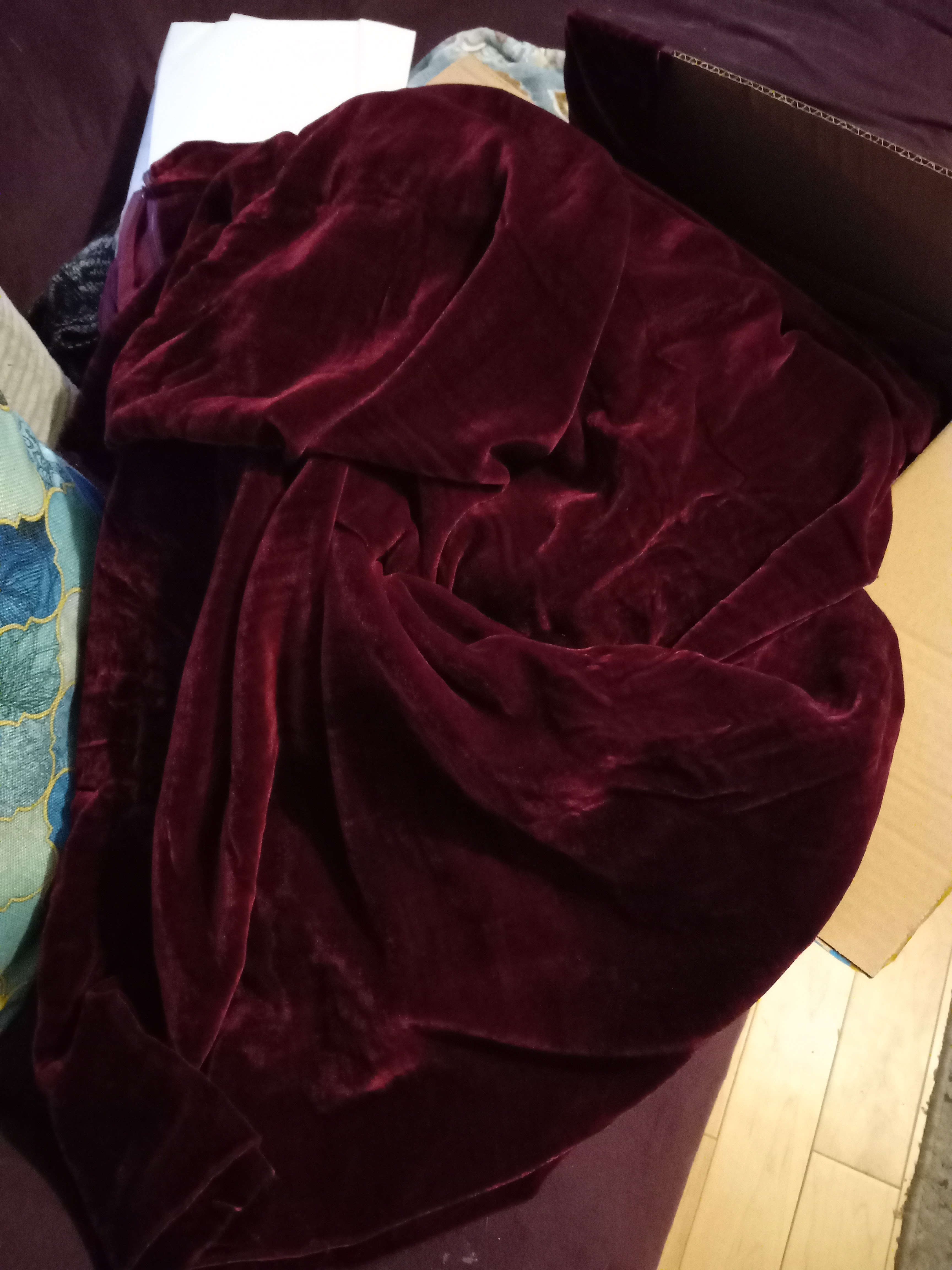
In my previous post I talked about how the original fabric I had been saving for this Houppelande was just not longer viable.  So I chose a plain weave 100% silk velvet instead. 

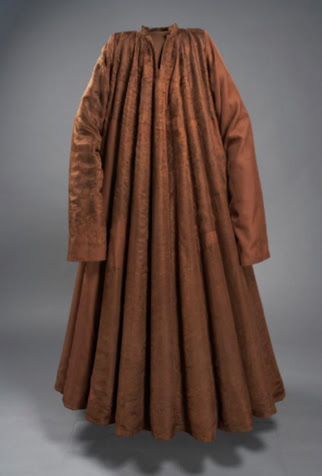
I was inspired by this extant velvet piece for it's color, and the embroidery shows it would have been a high status color. 


So why was velvet used?  

Well at the end of the 14th century Velvet and silk production in general exploded due to several factors. 

The increasing contact with the Arabic world had grown, bringing new trade, ideas, people and skills to Europe. Italian merchants had established trade relations with the Mongol empire in the 13th century and then settled into major cities throughout western Europe.

The black plague signficantly shifted dynamic of industry, allowing people to have more disposable income and creating a high demand for luxuries and exotic products. High Fashion became a mind set for the nobility and growing merchant class, and so was very lucrative. 

In Lucca, Italy Silk artisans relocated from after the black plague. And many new regions incouraged emigration of these highly skilled weavers, offering incentives so they too could be able to profit in the demand for silk. 

The raw silk was being grown and spun more as it had become more lucrative, increasing it's availability. 
 
Velvet production was a highly specialized and time consuming process, raw silk was imported, then spun. To weave velvet needed a highly skilled worker on narrow looms, and a lot of tiny rods to create loops in the fabric, which then would be cut. A skilled worker could produce around 25cm of 60cm wide plain velvet fabric a day, and often it would take an entire year to produce 60 meters of velvet cloth of gold. 

Velvet was then often dyed in expensive dyes, creating many vibrant or deeply saturated hues. Kermes dye being the most expensive and producing bright vivid reds. 

Then velvet was then exported throughout Europe via the Italian trade merchants who were already established in the major cities, especially my focus, Paris. 

Velvet also needs special skills to handle it. It's delicate, has a strong bias stretch and fraying easily,  has a nap that is easily crushed by ironing, creases or improper storage. Mistakes in seams easily damage the fabric, and it also dosn't handle pressure well, and needs careful consideration for the lining. 

So of course Velvet became the high status fabric for those who could afford it at the end of the 14th century. 

But due to the nature of the fabric it doesn't work well for highly fitted cottes that were the it fashion. So velvet became the material used for travelers robes and the fanciest Houppelandes. 

There are many examples of velvet Houppelandes in the inventories of this time. 

The extant Houppelande of John of Gorlizt was created in 1396 out of black (originally) silk velvet for his sudden death. 

See the translated article by Charles de Bourbon, or my pinterest board for more in depth information about this. More about the details of this in later posts.

I'm choosing the velvet because of the status it would had in period, because the extant Houppelande is velvet, because there are inventory entries abound for velvet Houppelandes, because the visual representation shows draping like velvet in most of the court spaces. 

But also because of it's own particular challenges with working with it. 

One such challenge is that period velvets had a dense weave which provided a bit of structure. However modern silk velvets have a chiffon ground, which makes them lighter, gives a lot of fluidity, and bias stretch to the fabric.  So I am choosing to interline the silk velvet with a 2.8oz linen. The linen will allow for embroidery while also to help achieve the period characteristics of velvet.  

This velvet also changes colors signficantly in different lighting.  From crimson to magenta! 

Burn test confirms it is 100% silk.


I chose the color because it's one of my favorites, because it's high status when the fabric is lacking some of the other decorative elements, and because I enjoyed the deep dive into studying kermes. 

Here is a pinterest board of extant red purple extant fabrics

Some more sources too

Silk and Patronage pdf 

The last velvet merchant of Venice

Cloth and Clothing in Mediaeval Europe, Essays in memory of professor E.M. Carus-Wilson 

  • Cloth merchants' inventories in Dijion in the fourteenth and Fifteenth Centuries, Françoise Piponnier 
  • Cloth in Medieval Literature of Western Europe, Raymond van Uytven
  • The Chemistry of Red Dyestuffs in Medieval and Early Modern Europe, Judith H. Hofenk-De Graaff
  • The Medieval Scarlett and the Economics of Sartorial Splendor, John H. Munro
The development of the Florentine silk industry: a positive response to the crisis of the fourteenth century, Sergio Tognetti 2005, Journal of Medieval History

Burns, E. Jane. Sea of silk: A textile geography of women’s work in medieval French literature. Philadelphia: University of Pennsylvania Press, 2014.

Crowfoot, Elisabeth Grace, Frances Pritchard, and Kay Staniland. Textiles and clothing, c. 1150-1450. Woodbridge: The Boydell Press, 2001.

Ertl, Thomas, and Barbara Karl. Inventories of textiles - textiles in inventories: Studies on Late medieval and early modern material culture. V & R unipress, Vienna University Press, 2017.

Farmer, Sharon A. The Silk Industries of Medieval Paris: Artisanal migration, technological innovation, and gendered experience. Philadelphia: University of Pennsylvania Press, 2017.

Monnas, Lisa. Merchants, princes and painters: Silk fabrics in Italian and northern paintings, 1300-1550. New Haven Conn.: Yale University Press, 2008.

Monnas, Lisa. Renaissance velvets. London: V & A Publishing, 2012.

Ferrand, Guilhem, and Jean-Pierre Garcia. Les inventaires après décès de la Ville de Dijon À la fin du moyen age: 1390-1459. Toulouse: Presses universitaires du Midi, 2017.

R.C. Famiglietti, Tales of the Marriage Bed from Medieval France 1300-1500, Picardy Press 1992

Scott, Margaret. A visual history of costume: The Fourteenth & Fifteenth centuries. London: B.T. Batsford, 1986.

Scott, Margaret. Fashion in the Middle Ages. Los Angeles: J. Paul Getty Museum, 2011.

Scott, Margaret. Late Gothic Europe, 1400-1500. London, 1980.

Scott, Margaret. Medieval clothing and costumes: Wealth and class in Medieval Times. New York, NY: Rosen Pub. Group, 2004.

Scott, Margaret. Medieval Dress & Fashion. London: British Library, 2009.

Snyder., Désirée G. Koslin, Janet E. Encountering medieval textiles and dress. Palgrave Macmillan US, 2002.

MEDIEVAL CLOTHING AND TEXTILES ·10· Edited by Robin Netherton and Gale R. Owen-Crocker
  • Clothing Distrained for Debt in the Court of Merchants of Lucca in the Late Fourteenth Century / Christine Meek 97

Sunday, 24 December 2023

Planning a houppelande, the details! Embroidery musings and Linings.


So in my previous post, I laid out a basic idea for a Houppelande that been bouncing around my head for years. 

This fabric I bought for it was purchased years ago, because it was silk velvet and a period pattern. However with the research I've done since, I recognize how blatantly modern the treatment of the gold flocking is, and was originally considering doing an all over embroidery to push it into a more medieval aesthetic. 

**UPDATE** I've chosen a new fabric I'm only going to be embroidering sleeves, one or both given the time frame I have to go on.


This is due to the time involved, delay with new fabric arriving and the fact that I can easily document one or both sleeves being embroidered, along with some possible epaulds, dagging and/or tassels. Although this a bit more of a masculine stylization, In period the patterning and drape of this garment would have been the same for either sex, but masculine garments tended to be more decorative. 


I'm purposely choosing a more masculine decorative style for this project because It helps highlight my skills, my knowledge of the grandeur that this garment would have had in period. Especially given the new fabric lacks any decorative elements. And it's extra shiny!


For this particular Embroidery project I am referencing this post on Embroidery for this period from the cottesimple, in addition to looking at extant embroidery textiles. 

Here is a Pinterest board of extant embroidery are artwork depictions. 
And a second focused more on the 14th and 15th centuries.


I've chosen this piece for my inspiration. I wanted something that was Gold work, clearly French, not overly religious and early 15th century, ignoring the figures, it is also something simple enough and can easily be done within my current skill level, resources and time frame. 

But doing an embroidery directly on a garment takes special consideration in the planning process.

An intresting tidbit concerning the Paris embroidery workshops-


Fashion Fabric Lining

*Update* even with the change in embroidery I'm still planning on lining it. 

Most my previous embroidery has been done on finished and unlined projects. For this project I simply don't want the embroidery to go through a lining, it's messy and needs to be protected.

So I have to consider how I'm lining it. (Not the removeable fur lining) In order to embroider the garment finished, I would have to bag line the garment. 

The problem with bag lining that I've experienced is that it's not as sturdy. The lining is a lightweight fabric, acting almost as a separate garment, and often seam allowances are unfinished. That tends to not handle the pressure on the seams as well, which means it tears. And to repair the seams means taking an entire garment apart. This could be helped by completely finishing the seam allowances, and adding pad stitching, but is a time consuming process that doesn't solve most of the problems. Because of the difference in fabric weight and stretch a bag lining always ends up wrinkling, at points where it is pad stitched, and major stretch at the hem. Not to mention pad stitching just dosen't look as nice as a seamless lining and I don't like the texture of it.

However, in my experience, flat lining is a lot sturdier. Because the lining and fashion fabric are treated as one fabric during seaming, and then flat felling the seam allowances, creates two lines of stitching that allows the lining to share pressure with the fashion fabric, adding strength. The seam allowances ends up completely encased, without much chance to fray. The lining also dosen't stretch as much, and rarely needs pad stitching. If a seam blows out, then the repair is much simpler. Flat lining is simply is less work also. 
 
I theorize that bag lining became a more popular choice for garments with the invention of the sewing machine. 

I also have the added problem is that modern silk velvet has a chiffon ground, that has no structure.

In such a large garment of silk velvet that has a lot of give and stretch, there is going to be a lot of pressure on the seams, and it's going to need a stabilizing interlining, I am choosing a lightweight 2.8oz linen for the interlining which will help the silk velvet behave and move more like period velvets, in addition to providing a stable ground for the embroidery. It has the added benefit of  reducing the amount of the vivid fashion color that will ghost through to achieve the snow white lining that was fashionable.

So this interlining will be flat lined and felled with the velvet for strength and integrity of the garment. 

I've chosen a simple white satin 12mm silk for the visible lining. It is comparable to silks in the inventories chosen for linings, and the simple white will not change the aesthetic of the houppelande if the fur lining is removed, while hiding any embroidery threads. Plus shiny satin was in vogue. 


One observation by Famiglietti stands out- In 1401 Duke Phillip ordered 102 gowns (Houppelandes) in green velvet lined with white satin for his son's wedding guests to wear. The two for the Duke and his Duchess were matching, each with one sleeve encrusted with jewels, and the other sleeve had their initials embroidered in crimson and encircled by foliage of Pearls. (Tales of the Medieval Marriage Bed 1300-1500, R.C. Famiglietti,  p65)

But, for this project I am currently only adding embroidery to one sleeve. But do plan to add more in the future. 

To keep the future embroidery backside mess hidden and protected, then I'll need access to the interlining. I have no choice to bag line the satin. The flat lined and felled interlining will be taking on the pressure of the garment so the satin will not be a strucural element. So despite the extra work of additional stiching I'd rather not have to take the gown entirely apart to add future embroidery. 

I'm going to use a needle point scroll frame that can turn the fabric, similar to the one pictured below. (Embroidery hoops are inconsistent and would damage the textile.)

I'll have to cut my fabric into the panels, which also happens to be consistent with narrow loom fabrics of the time, then mark the diagonals on the cutting pattern so I'm not going to be cutting through any embroidery. 

*Update* new fabric is narrower by 9" so now I have devised a new cutting pattern based on more period widths of fabric. 


For the fashion fabric, the lining, and the interlining for the fur, I'll be using this cutting diagram, and piecing the linings as necessary, pretty much ignoring the fact that half the fabric will lay upside down. It's period to do so, and even the extant garment I'm basing this pattern on has velvet panels with the nap changing directions. 

Look at the piecing on this extant velvet piece from the Cleveland Museum and the fact that the embroidery was clearly done after the piecing was. 

But with the fur, it's a different story. It's has a nap that *I* simply cannot ignore. 
Have you ever pet a furry pet backwards? It's not exactly the greatest, and with my sensory overload issues I cannot. So even though I'll be using plates, I'll also have to order extra plates and do a lot of disassembly and piecing to make it work. 

I'm still in the process of choosing the right fur for this project which will be another post!