Showing posts with label fur. Show all posts

Monday, 17 June 2024

A Fur Blanket

So this project started out as a joint project between Godefroy at Lyon Fur and myself for a teaching opportunity at the open fur workshop at Warriors and Warlords last year. Being how busy and hot that event was, the project wasn't completed at the event. Due to health, life, and other projects of higher import, this project sat in my project pile for nearly a year, but now that camp season is here again, I wanted it done for chilly nights, plus it would be good way to refresh my fur skills before attempting the houppelande lining, and I simply needed the space it was taking up for other projects in the works.

The Historical Precedence

Visual imagery of fur Blankets- 

There was surprisingly small amount of visual evidence of fur blankets. Most bedding features a colored top and snow white back that can be seen when folded over. That snow white could depict a white fur, or most likely white linen. 

However I have found several images that clearly depict fur being used as a blanket. 


A link to my fur blanket image Pinterest board

But we do see the majority of fur blankets had a decorative top and the fur underneath. 

This one in particular was inspiring, because although the grey underside could be debatable as fur, the pattern is similar to the fabric I chose for this project. 


Mentions of fur blankets in writing-

Like the images, fur blankets are not often mentioned in the inventories, reserved for the nobility as it seems like the majority of fur use was for wearable items, and the majority of blankets are wools or serge lined with linen. 

But here are two examples I could find of fur being called out as a blanket-

30. Noble Jehan Sauvegrain, seigneur de Baurates [sans lieu] 1397, novembre (Les inventaires apres deces de la ville de Dijion a la fin du Moyen Age (1390-1459) tome I : 1390-1408)
  • Item 1 coverteur de gris que l’en dit estre a maistre Jaques de Chevanches selargien qui est en gaiges pour XX frans ; (Item- 1 coverture of gris that is to be bought by Jaques de Chevanches for 20 francs)
  • Item une coutrepointe de velvel noir fourre de gris blanc et par dessus de soye noire: (Item- 1 black velvet quilt furred with Gris (and) Blanc, topped with black silk) 

The first item being a simple grey squirrel blanket, and the second seems to be a checkerboard of grey and while squirrel, and black velvet and silk on top. 

As I discovered in my houppelande research, white, especially linens, were thought to purify and cleanse the body, and given sweat and other human secretions, bedding would want to be washed often for odors and pest control, just as people do now days. Beds often were enclosed with drapes, trapping in body heat, so I suspect most folks would use their fur lined mantels on top of existing bedding when needed.  A fur lined blanket wouldn't have been a necessity, but instead a display of wealth. 


The Process

Godefroy ordered a 2m x 2m premade white rabbit plate, and a couple dyed black rabbit skins, thus chosen for it's economical cost, and to showcase the powdering technique that was used to create faux ermine in period. I chose to use a linen/silk blend fabric from my stash for the interlining, and a 4.6m meter length of 30" wide Fleur de Lis silk, neither of which were quite enough for me to use as a garment. 

Fleur de Lis extant fabric, silk with gold thread. 13th century Italian.

This fabric also would have been considered a bit out of fashion for my persona, so makes it a great choice for bedding since the typical cycle was for a fashion fabric to become decor fabric once out of fashion. 

I do recognize that rabbit (coney) would have been considered a lower status fur, and would have been unlikely to have been paired with luxury silk, and a simple linen would have been the choice for interlining. But this project isn't meant to be a reproduction, but an object that would have been recognizable in period, and at the time of conception this project needed to be budget friendly. 

I prepped the interlining and silk cover beforehand. The size of the blanket was determined by the size I could eek out of the silk, by adding a 4" black satin ribbon as a border, I ended up being able to piece together a rectangle of 74" by 70" wide. While piecing willy-nilly is very period, I did manage to match the pattern to make the piecing almost seamless. This cover and the interlining were machine sewn with silk thread and the silk seam allowances were treated with a zigzag stich to prevent fraying. 


We then cut the fur down to 72" x 68", slightly less than the cover. 

And went about marking out our placement of the powderings. We made sure to verify the grain of the fur. We want the spacing to be similar to that of what ermine tails would have been in period. For this we chose a pattern of 10" apart in rows 4" apart, staggered, using a straight edge and a small elongated diamond template to mark each one.  Making sure to orient the diamond template so the long edge is the same downward direction as the fur.

You can see the grain arrow, the lines and even a diamond we didn't get cut out.

Once marked, we would cut through the leather only with an exacto blade in the white bunny, and then also use that template to cut a black diamond from the black bunny, again making sure to keep the long end aligned with the downward fur direction. We then used a fur machine to insert the black diamonds into the white ground. A few of them were hand sewn in by whip stitch, which is the same kind of stitch the machine makes. At this point we had achieved a corner of the powderings inserted before time ran out and it sat in my pile. When I picked up the project, there was no more time for more powderings, so it will remain a feature. 

The next step was to attach the twill tape to the edges. The twill tape helps protect the edge of the fur, gives a nice finished edge when turned over, and a place to attach the interlining and fashion fabrics to without damaging the edges. The twill tape is sewn onto the fur side, and folded over to the leather side.

Again this was done by machine. 

Once the the twill tape was on, I folded it over to the leather side and tucked the ironed interlining underneath, making sure to center the interlining in the right direction. Then hand stitched it all down with a heavy quilting cotton, using a leather needle and a thimble, making sure to pierce through the leather.  Because fur is thick, and forgiving these stiches are close to 3 per inch, closer stiches are perforate and tear the thin leather on the fur. 

I noticed that the edges on the top and bottom of the fur stretched at some point, making it not square, and the bias tape then wrinkled when flipped over, and I had to be careful stitching to manipulate it flat, one corner was bad enough for me to rip apart completely and cut off a couple inches to get it square. 

I suspect that if I had pad stitch the interlining before the twill tape it might not have stretched so much. Those were also the edges where the machine kept skipping stitches and went over twice.
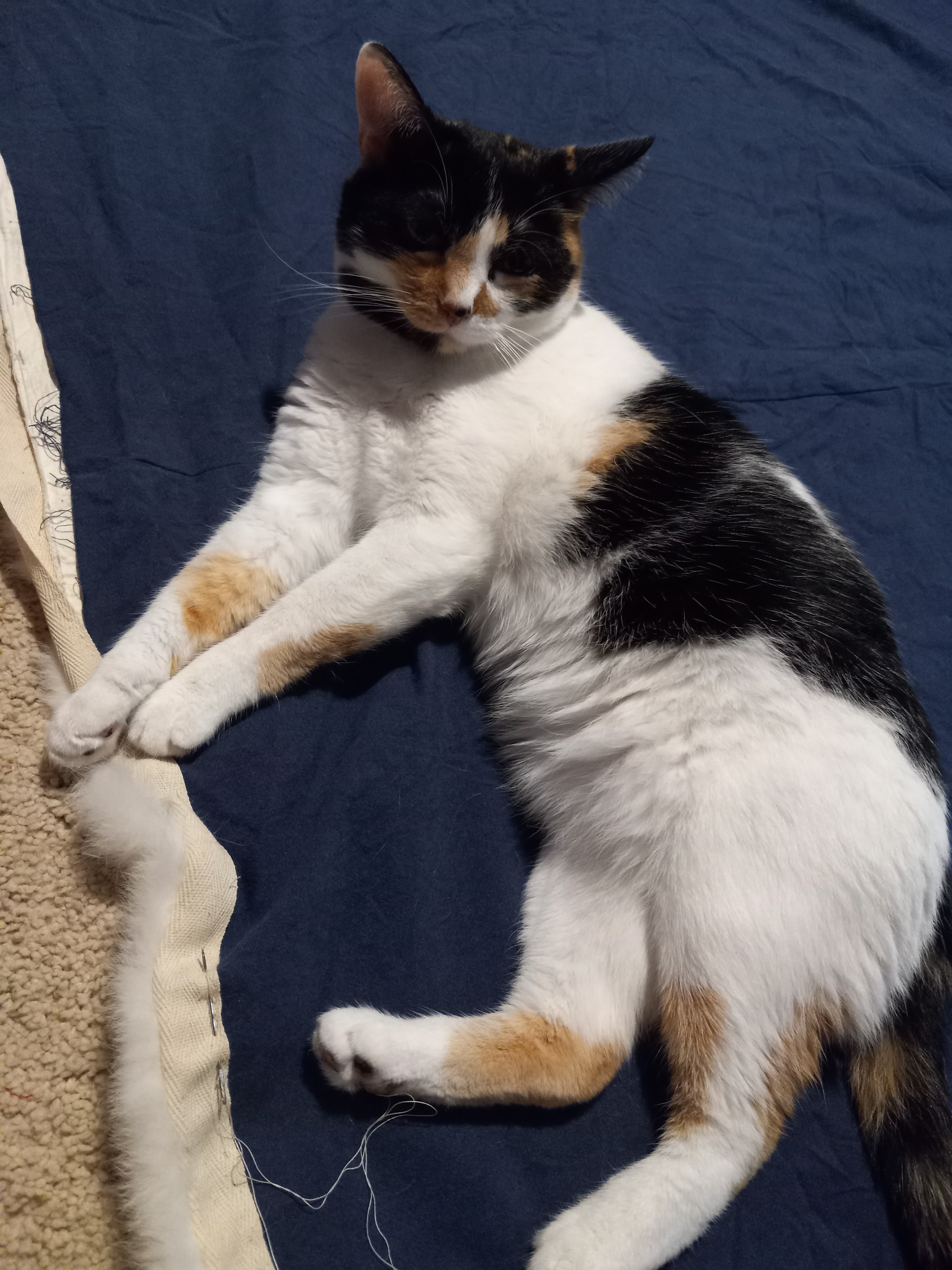
Dauphine is here to "help" show you! 

Then the process of  quilting the entire thing! This was done mostly laying on the floor with a pillow under my ribs. The quilting pattern happened organically, each corner needed to be stitched down as I was sewing the till tape to prevent it from shifting, because I needed to know where the center point was for the fashion fabric, the center cross was done. Then I continued to fill in the pattern from the corners in each quadrant. Each row of stitching is about 4" apart, and the stiches are close to an inch apart. I didn't measure anything and just eyeballed it. Since this is a hidden layer it didn't need to look pretty. Also because of my 'helpers' and lack of space I had to  fold this up and put away frequently, and the linen likes to wrinkle in this humidity. I should have done the quilting before the edges to make sure the fabric was perfectly smooth, but didn't so there are a few places where it wrinkles slightly. 

My other "helper" Vagabond being a fabric weight.

And then we repeat the quilting process with the fashion fabric. This time I centered the fabric and started quilting in rows from the center out. For this I used the silk thread that matched, and used invisible top making sure my needle passed between the interlining and the leather before creating a tiny back stich on the surface. The invisible stitch makes it so that the stitching wont ever catch and tear which has been a pet peeve of mine with many blankets and quilts in the past, and also doesn't distract or mar the fancy silk. 

See the red line for an approximation of the top stitching

At some point in the beginning of stitching the top down, it shifted an inch and I didn't notice until I was at the edges of pad stitching. Leaving some sections of the border a half inch, and others 3". Doh! I suspect that part of this was caused by the top stretching when I applied the bias tape, and I wasn't paying enough attention to that detail. 

It was too noticeable of a mistake, looked SO sloppy, and I just couldn't. Nor was I going to rip out and redo 15 rows of invisible top stitching. So instead I removed the border, and took fresh 4" black satin ribbon, and top stitched it to align with the edges of the fur, and let the silk be skewed underneath and it you can only tell it's off if you really look at it. It also gave me the opportunity to add a touch more bling, in the form a gold cord.   


Concept of updated border. 

I'm happy with how this project is turning out, but if I did it again I'd create a quilting frame so that it wouldn't be bothered by my 'helpers' (seriously couldn't keep them off it, and the protestation when I locked them out was epic) and stay in place for the duration of the project in addition to being a lot more ergonomique to work on. 

I would also use an edging that was real silk satin, and probably more bling, but this was originally a stash fabric project to focus on the fur work. 

I'd also wait until after everything was pad stiched to put on the binding, and the issues I had with things not being square by the end would be sloved if I could have squared it up at the end. 

We don't have any surviving furs from period, fur is a natural material that degrades fairly quickly if not maintained, and so most of our knowledge of fur work comes from vintage sources. Twill tape for binding was common practice on vintage items, however I learned after the start of this project that the text by Veale stated that leather binding was used at the end of the project. I also discovered during the interm that the twill tape binding on my fur trimed gown, plasteron, and tippets, held on to dampness and caused the fur to become crunchy, needing to be replaced in a few short years. Since I was on a budget and timeline I chose to still use the twill tape since this shouldn't be on damp ground. But then twill tape also stretched different than the fur leather did while attaching it, and a source of later frustration. 

A leather binding at the end as indicated by Veale should minimize a lot of the problems I had.  

The gold cord helps to pull this together nicely.


Now I've noticed how much this blanket looks like the background of a 14th century Manuscript painting.  

And how sexy it looked in my camp!


Resources for fur- 

Grant Johannes (Aka Godefroy du Lyon) at Lyon Fur. 

A fur primer for 14th and 15th century European clothing by Tasha Kelly at Cotte Simple

Veale, Elspeth M. The English fur trade in the later Middle Ages. London: London Record Society, 2003. https://www.british-history.ac.uk/london-record-soc/vol38

Delort, Robert. Le commerce des fourrures en Occident à la fin du Moyen Age (Vers 1300 - vers 1450),

Clothing in the Court of Burgundy 1.1.2 The Furs (English translation per Charles de Bourbon)

Wadmore, James Foster, Some account of the Worshipful Company of Skinners of London, being the guild of corpus christi, Blades East and blades, London 1902


Thursday, 1 February 2024

Houppelande Details- The Fur Lining

So two common questions I've been asked with this project is why am I choosing to line the the velvet with silk, when there will be a fur lining, and the why will the fur lining be removeable.  And they have a similar answer. Versatility.


Schachzabelbuch - Cod.poet.et phil. fol 203r | Fur workers 1467 Dutch

Originally this project scope a fur lined court Houppelande-

  • Fur was an essential material used in the construction of period garments, So much so that the fur work would cost much more that the materials and labor for the rest of the garment. Furrier guilds enjoyed more status and power that the silk industry. And there were many regulations that showed how important this industry was in period.
  • I am attempting to recreate a high status garment of the nobility, and the nobility tended to occupy stone building that tended to stay cooler in all but the hottest weather. 
  • Outside of multiple layers of wool, fur was the most common way to create warm garments, and I tend to run cold. 
  • Accounts and the surviving art show most of the houppelandes that are made of silks, velvets and other high end textiles of similar caliber to the silk velvet and gold work I am using were lined in Fur. (Inventaire du mobilier du chateau Chailloue de l’annee 1416, p IX, 7, 11, 12, 13) (Inventaires apres deces de Dijion, entry 30, 31, 62, 63)
So why make the fur removeable?
  • Clothing tended to be a larger percentage of one's income than it was today, Clothing was a valuable enough asset to be willed out, was considered valuable gifts, and there was thriving second hand market. As such people tended to have a lot less garments, and replace them less frequently. Noble court attendants and servants alike tended to be gifted a new length of fabric at Christmas and Easter for the creation of  winter and summer outfit. If you are only getting 2 outfits a year, then clothing needed to be long lasting, versatile and cleanable! In a time when social standing was reflected in your appearance, it simply wasn't socially acceptable to let one's garments fall into disrepair.  
  • Having a removeable fur lining meant it would be easier to access the interior of the garment for repairs, make it more adaptable to the change seasons, and make it so the fashion fabric could easily be cleaned without ruining the fur, and the fur cleaned and reconditioned. 
    • Some of the post mortem inventories of southern France list houppelandes with a lining and also with fur lining. We also see a lot of entries of a non furred houppelandes followed by a pelisse (a separate fur garment) or a body fur without sleeves (Inventaire du mobilier du chateau Chailloue de l’annee 1416, p 7)
    • Veale opens her book with a story about a maiden who hurriedly removed her fur lining, and then wore her gown in public to impress a suitor, and other that her lack of warmth turning off for the suitor, this wasn't met with any social reproductions that wearing and unfinished gown would have. 
    • The Goodman of Paris instructed his young wife to recondition furs that had become stiff from moisture with wine, 'Sprinkle the hardened fur with wine, sprinkling it from the mouth as a tailor sprinkles water over that part of a gown which he wishes to shrink, and then scatter the best flour upon it and let it dry for a day; then rub the fur very hard . . . until restored to its previous condition.' indicating they could be removed to not damage the fashion fabric with wine or flour.
    • Fur linings typically had their own lining of linen and edged with leather. "Often skins were backed with canvas or other lining and, when stitched into a gown, their edges were bound with fine leather (Veale).
    • A few accounts show finished garments being sent to the furrier as the last step of the process.  
    • Accounts show that Furriers where often tasked with the job a cleaning fur linings with chalk and then basting them back into the garment. 
    • We have an illustration from the 15th century showing a furrier sewing a complete garment of fur (possibly a pelisse).
    • Statues show that used furs must be sold with their original garment, showing that the fur could easily be separated.  
  • I also have chronic illnesses, and sometimes the weight of this garment might exceed my limits, so having the fur lining be removeable will make it be versatile for my changing needs. 
So why then another silk lining for the fashion fabric?
  • The silk satin lining on the fashion fabric is the scope creep that I am choosing to make the garment versatile, and longer lasting. 
  • It maintains the visual aesthetic.
  • It hides and protects the backside of the embroidery, and interlining needed to stabilize the velvet.
  • The additional weight of 12mm satin is negotiable and has zero effect on the drape. 
  • Some of the points about removeable furs also point to a fashion fabric lining. 
  • There are several accounts of velvet gowns lined in Satin, so it is documentable. 
    • In 1401 Duke Phillip ordered 102 gowns (Houppelandes) in green velvet lined with white satin for his son's wedding guests to wear. The two for the Duke and his Duchess were matching, each with one sleeve encrusted with jewels, and the other sleeve had thier initials embroidered in crimson and encircled by foliage of Pearls. (Tales of the Medieval Marriage Bed 1300-1500, R.C. Famiglietti, p65)
    • Une Houppelande de veloux fourrée de satin noir "A velvet houppelande lined in black satin" (Inventaire du mobilier du chateau Chailloue de l’annee 1416, p IX)
    • The Dijion Inventories mention a lot of Voilet, which is an odd way to denote purple, and due to a lot of other clear misspellings or mistranslations, and the consistent use of Voilet in places where one sees velvet in other inventories, and no other references to velvet, and the price, going forward I'm assuming Voilet is a meant to be velvet. (See entries 30 and especially 31) There are also a lot of entries for "fourree de blanc" in context this seems to be shorthand for undyed silk or high quality wool, that was ubiquitous by this point.

Choosing a Fur!

Reading through the 1416 castle inventory, prosperous accounts from Dijon, and antidotes from several authors, I see a trend emerging. Houppelandes of expensive silk fabrics often are more often paired with silk linings in Dijon and the south of France, But Northern markets priortized fur linings. In order of market cost, low to high, common rabbit, summer/red squirrels, fox, gris (most popular option), white rex rabbit, white lamb, white lettuces, black lamb, minivair, black squirrel, marten, and ermine are all found. Women tended to have white and less expensive furs while men prefered black fur of higher value, but that isn't always the case.

The vouge fashion in 1415 was for black/grey/white furs, since they would need to be imported. (Veale, Delort, CdB) 
 
*I might insert a chart here if I get ambitious*

That is a lot of Options!

So narrowing it down to what is right for me and the project. 
Factors include loft of the fur, suppleness of the skin, and the overall weight of the fur.
I don't want the fur to be too lofty, or stiff to ruin the drape of the velvet, and I do want to reflect the higher status as much as possible.

Considering the size and amount of fabric involved in this project, choosing items of less weight is a huge factor.  The silk velvet is 1.5kg, the linen interlinings 2kg, the habotai .3kg, plus various notions, is close to 5kg (11lbs), before factoring in the fur or the weight of the goldwork.  

So process of elimination-
  • I'm allergic to rabbit. 
  • Martin/Sable is too expensive.  
  • Fox is too lofty, too heavy and expensive modernly. 
  • Budge (or lamb) is to heavy for my goals. 
  • Red squirrel is available and affordable, but it is a lower status fur, also a bit stiffer and heavier than I prefer.
  • Gris while was an economical mid status fur of great popularity in period is ironically too expensive modernly. 
  • A sample plate which I thought was black squirrel in the photos ended up being a dark redwerk that was too stiff and heavy, so no black squirrel available. 

BUT! BUT! BUT!
Ermine- Luckily, my fur source (Lyon Fur) was able to stumble across some older "ermine" plates from his vendor that are affordable, and would be a more fitting fur for this project. It is light weight, low loft, supple, and a high status fur. Judging from the size of the skins in these plates, It's clear these are of the long tailed weasel instead of the short tailed ermine, but even in period it was common to mix up Ermine and Lettuces. (Delort) I'm currently waiting for a sample to arrive and the plates to be reconditioned.  If these samples turn out as we suspect they will be, then I plan to powder the sleeves with a skin dyed black, as was done in period to achieve the classic ermine look. 

"Erime" plates before being reconditioned. The yellowing and wrinkling should be minimized by the process.  

I'm anxiously awaiting for the results of the process.  

See the ermine on the Queen's sleeve, and collar, and fur peaking out at her hem? That's the goal here. 

Minivair- which is fading in popularity by 1415, and is a bit expensive, but is a viable option, especially if paired with a demi vair in non visible places. It has the right weight, loft and passible status. This will be my second choice.


Custom plates-

Fur work is often guess work. Tanning and preservation methods on fur can only make it last so long, and so extant fur examples simply don't exist, as far as I know. So we base our knowledge off surviving documentations, which can be vague at times, and needs a bit of extrapolation to figure out, with the help of surviving vintage furs that are clearly post period.

We see in the fur books by Veale and Delort, that the guild statues outlined very strict regulation for standardized fur plates sizes. Ermine and minivair were regulated to 8 tiers of 120 skins per plate (Veale). Other varieties of vair were regulated to 48 or 52 skins per plate (Delort), thus creating standard sizes, 55-60cm wide, that closely followed the silk loom limitations, and would have been a grab and go option for the majority of people. 

However we see that custom garments where often exempt from these standards-

"Certain furs, having been made for a particular gown, varied more considerably in size: Edward III in 1342 bought furs of squirrel made of anything from 80 to 760 skins, whereas the standard fur of eight tiers used only 120." (Veale).

And in these examples-

"a gown made in 1531 at a total cost of £66. 16s. 4d. The eleven yards of black Lucca velvet cost £10. 7s., and 12s. was charged for the making of the gown; the 1,046 ermine skins cost £34. 17s. 4d., the 18,000 'powderings' £9 and the sum of £12 had to be paid for the work on the skins."(Veale)

"Skins of pured minever were about 5½ inches long and 1½ or 2 inches wide, and even to sew together the 120 skins usually put into a fur of minever of eight tiers involved the sewing of over 400 seams." (Veale) 

In that last example, if we use the standard size of ermine and apply it that 11yards of fabric, assuming 55cm wide, the amount of skins ordered implies that there wasn’t many waste skins. Indicating these were custom plates made for this specific garment, and given the standard wage for furriers of the time (4-6p per day), it amounted to over a years worth of fur work. Presumably then the nap of the fur would be the same direction. This is something we see commonly in the noble and royal accounts- Individual skins are being ordered instead of standard sized furs. 

So for my project, I want to have the fur nap align as much as possible, and since it is clear fur work was customized in period by the nobility, I too will be adjusting my plates to be customized for this gown so that the fur can be the same direction with little waste. 

However, I'm am busy with modern adult life, so even though I'll be disassembling standard fur plates to make custom platesand going through the process of powderings on the sleeves, I simply don't have the ability to put a year's worth of hand sewing into it. So I'll will be using a machine specifically designed to sew fine furs. Plus the pates already come machine sewn, and the machine stitching does not change the way the fur is assembled or they way it functions. 

Backing and Binding the fur lining. 

In Veale, it is mentioned that fur is often backed by linen, and the edges bound in leather. 

In addtion, to prevent the fur lining from stretching out of shape, it needs something to pad stitch too. So, I have decided to go with a lightweight linen for backing. I am waiting for fur sample to arrive before choosing weather to use a 2.8oz or 3.8oz linen. I have to consider the weight and whether the lighter weight is appropriate enough for pad stitching the fur. I will update with my choose and thoughts behind it.  

In pervious fur projects I have used twill tape for binding. It's something that was used often in vintage furs. But in period a small woven band would have been extremely laborious and my observation is that they are generally kept as visible elements as trims and belts. Plus my personal experience shows that the twill tape on a hem that touches the ground absorbs moisture easier and then keep the fur damp longer which makes it crunchy and damaged when it does dry. 

A furrier is already working with animal skins, so they would have easy access to leather. So it makes more sense to follow Veale's statement and use leather for binding.  

So with that knowledge I have choosen to get a couple supple lambskins to be cut into binding strips. I'm choosing white lambskins, because lamb is a fur often used in garments, and so would have been an easily available leather for the furrier. It's also soft, thin, flexible, and is lightweight so makes it ideal for binding for this project. 


And again, due to modern time restraints, I'm probably going to use the machine to attach the binding to the fur. 

But I do plan on making a small hand sewn sample just to highlight how it was done and the sheer amount of time it takes. 

Sources-

Inventories-
DALME online inventories

Inventaire du mobilier du chateau Chailloue de l’annee 1416

Les inventaires apres deces de la ville de Dijion a la fin du Moyen Age (1390-1459) tome I : 1390-1408

The household inventory as urban ‘theatre’ in late medieval Burgundy

Dressing the King and the Beggar: The Various Levels of the Textile Market and their Prices in Medieval Valencia (13th - 15th centuries), Juan Vicente García Marsilla

Household Inventories of Medieval Europe

Snyder., Désirée G. Koslin, Janet E. Encountering medieval textiles and dress. Palgrave Macmillan US, 2002.

Ertl, Thomas, and Barbara Karl. Inventories of textiles - textiles in inventories: Studies on Late medieval and early modern material culture. V & R unipress, Vienna University Press, 2017.


Fur-
Veale, Elspeth M. The English fur trade in the later Middle Ages. London: London Record Society, 2003. https://www.british-history.ac.uk/london-record-soc/vol38

Delort, Robert. Le commerce des fourrures en Occident à la fin du Moyen Age (Vers 1300 - vers 1450),

Clothing in the Court of Burgundy 1.1.2 The Furs (English translation per Charles de Bourbon)

Wadmore, James Foster, Some account of the Worshipful Company of Skinners of London, being the guild of corpus christi, Blades East and blades, London 1902


Economics-
Guilds in the middle ages pdf ebook