Showing posts with label cotte. Show all posts

Monday, 1 January 2024

The Griffin Needle Challenge Gown


Griffin Needle Challenge is a local garb competition event, basicly you grab a team of 6 and plan to sew an entire outfit from the skin out over a 24 hour event. I participle most years,  but this was the first time I sponsored a team, and was the model.

Before the event, you are allowed to pattern a garment, and create certain accessories ahead of time, but all fabric needs to be uncut and unmarked. We chose as a team to do a Pyx level entry, which meant everything was hand sewn. We ended up with a team of 5 people, and my co-lead couldn't make it, but at the end of the event we had some help from another individual there just to geek out and work on projects.

Typically this is a Judged A&S competition, but seeing as we ended up being the only team able to compete, it wasn't really a competition, but I was evaluated for our creation, and I am pretty proud of the work that went into the research, and how the team worked together to pull this off.

This Gown was inspired by Les Tres Riches Heures du duc de Berry; Avril. Cira 1416.


My documentation is here. In my documentation, I was trying to emphasize the importance of aesthetics in midieval society at this time period. While my inspiration is the manuscript above, it is only a visual, and the bulk of my research is based of the French inventories of the time period, trade, and sumptuary laws, along with many other manuscript artworks of the time, and extant fabrics.

My documentation also fall short of Chicago style citations, but at this point, I truly don't have the bandwidth for editing it any further at this moment.  

The pattern was one that had been updated and used on garb just a few months prior to this event. See My previous write up here This is a curved Seam front, with armscye at my pivot point. It also has a bit of ease in the garment to be a pull over style since the simple cotte underneath will be doing the work of actual support. 

Here are a few in progress shots of this gown at GNC! 


Due to the nature of having a 4 person team at an overnight hand sewing competition, not everything on this gown was finished. Plus this fabric wasn't the most supple to work with and was tedious to hand sew. 

Basicly everything from the waist down was just basted to together. None of the seam allowances finished, and the neckline and hem were still raw, and not cut to shape. And the sleeves were swapped!

Which turned out to be a good thing. 

After GNC the project sat in a basket for some time, because real life. And when I had the time to pick it back up, there were definitely some adjustments needed. 

My "helper"

Firstly the fabric was so stiff. the lining and the fashion fabric clearly had a significant amounts of sizing on them making them difficult to sew. So I found my largest lingerie bag and but the gown in the handwash cycle in my machine and let it air dry.  It was much more supple and workable. 

Then, I had to take off the sleeves, and pick apart all the basting seems from the waist down. 

Then the slow process of hand sewing all the seams with a running back stitch, and flat felling the seam allowances. I like to flat fell my seam allowances, because I have found it to be the most durable seam choice for the way I wear my gowns. Gowns that are tight fitting, frequently get stepped on, and washed, need strong sturdy seams, and I found that encasing the seam allowances prevents them from fraying, adds a second line of stitching, and locks in any flat lining I might have, making my gowns *me proof* lol. 

I estimate it was 20 hours of hand sewing just for this task. 


After the seams were together I let it hang for a few days. So that the bias stretch could sort itself out before hemming. In the mean time I started to edge stitch the sleeves... And that turned out to be problematic. I got done with edge stitching one sleeve, and then realized how badly the lining had stretched. See my previous post! 

And so I went to work tearing those completely apart. 


I ended up with 4" of vertical stretch and 1" of horizontal!

And then spent another 4 hours trimming and sewing the sleeves back to their original state. 

Edge stitching isn't something I am sure is period or not. But it's something that I learned many years ago to help keep any edges crisp, especially on curved hems, without having to figure out how to iron at a camp event.  

It's kind of a variant of stay stitching.  I iron the edges, and then pin them while still hot.


In this case I chose a black silk thread because it disappeared on the brocade surface, and it is essentially a back stitch, but on the side of the lining the back stitch is tiny so that all you see is a line of tiny dots at intervals. 


And the result is a basicly invisible stitches, but a edge that stays crisp without needing to be ironed! It also has the effect of keeping the seams from busting out because there is another line of stitching holding it together.  Again *me proof*.

At some point in this process I tried this garment on and realized that the bust wasn't quite giving the shape it should have been. The gown was flattening my bust, and pushing it up, much like a silhouette that is later in the century, instead of the more natural silhouette of this time. And It was much harder than it was to slip it on and off, yet looser in the waist.


Turns out bodies change. In the months since patterning the gown and now, I gained an inch in my bust, and lost some around my waist, Go figure. So to fix that issue I tore apart the side seams and added a small gusset on either side, to help alleviate the bust squish and to keep it a pull over style. I also made minor adjustments to the shoulders and armscye. Then finished the neckline. 


So for those following along, that ends up being redoing almost every seam on the entire gown. Sigh. 


After letting it hang I finally could trim and hem the bottom. 


And a picture of the inside of the gown, in all it's handsewn glory!


I've spent at least 80 hours of hand sewing for this garment. Plus at least 20 pattering, ironing, cutting, seam ripping. Not to mention countless hours of research and previous experience. 

A few more photos of the finished Gown!


And a little helper who thinks she's being sneaky....


Wednesday, 4 October 2023

Oh! The layers! The basics of a 14th or early 15th century wardrobe.

A dressed lady of the 14th or early 15 century would wear at least two layers, most often 3 or even more depending on the occasion or weather.


The Under Dress-

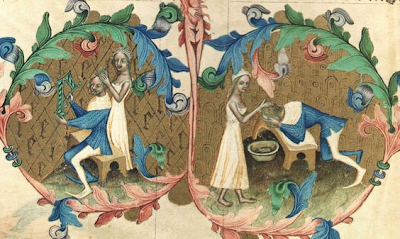
In the 14th century bathing was still popular, although it did wane as the century progressed due to fears of the plague. But the best way to stay fresh in the 14th century was to have the proper undergarments. The underdress was meant to absorb sweat and body oils and help protect the subsequent layers from odours. This layer was often pure linen which was known to wick moisture away, withstand harsh lye soap, and get softer and more comfortable with age.

Undergarments would be changed daily, aired out between wearing's and washed weekly. Then laid out in the sun to bleach out bacteria and odors. Oftentimes people also would have linens that would be used for daily rubing of the body.

While body linens are not note worthy in the French inventories I have studied, There are quite a few different sources of undergarments throughout the 14th century, both written and depicted in art. In both there is quite a bit of variation. You can see many full long sleeved garments depicted in the artwork earlier in the century,

Most depictions of undergarments are very similar to the image on the left. A slightly shaped garment, to mid calf with long sleeves and a neckline low enough to not show when under other layers. This would have been to go to standard. Due to ease of construction, functionality, and ability to hold up to washing.


Bible of Wenceslaus IV of Bohemia, 1389

However, In writing there are descriptions of breast bands, binding, tightly laced undergarments, and even breast bags sewn into them to support the bust, even early in the 14th century. The Tyrol Castle finds are a great example of this. There are some sleeveless options depicted in the 1389 Wenceslaus bible- some of which show front lacing.

Chemise ladie's undergarment, 14th century,
castle Ranis, Thuringen (Germany
A History of Costume; Kohler.

There was an extent garment that was shorter and sleeveless like a modern-day slip as shown on the left, however, it has been lost. The surviving image shows narrow shoulder straps, and a wide low neckline, very similar to a modern tanktop.

So my take on it is that the undergarments were largely a personal preference based on your body type and the amount of support you are trying to achieve.

Linen-

It’s a fascinating thing, in both the 1390 Dijon and Chateau de Chaillou inventories I've been studying, there is very little mention of anything I can discern as being undergarments, however, the French Inventories of this time mention various places where linens were acquired, Reims, Paris, Lincoln, etc… each with an easily discernible quality by sight. It is clear that linen tends to be graded by the place it came from, and each has its own price, and therefore an assumed quality.


The Simple Cotte or Kirtle in English-

Please note that the fitted cotte is the foundation layer for all classes, and when the nobility is in domestic or agricultural scenes doing actual things, they can be depicted in the fitted kirtle with long fitted sleeves. It would be the equivalent to leggings and tee shirts in the modern world. Most often, outside of the home or field, the majority of women would wear a fashion layer over this.

The inventories show that simple cottes were most commonly made of wool, for all classes. Wool is ideal because it breathes, it wicks away sweat without holding onto odors. It has just enough stretch and give to move with a person, while still maintaining support. Often in extant examples of sleeves, we see narrow bands of silk used as facings or as structures for necklines, lacings, or button holes.

A highly fitted garment has a lot of pressure on the seams- most medieval buttons would not hold up to being the support needed for the shaping provided by these garments. Supportive cottes appear to be laced in the torso, down the center, or possibly down the sides, or a pullover style (while still being fitted). See Festive Attire and Cotte Simple for more about period lacing.

This means that the job of support is totally up to the kirtle or in some cases the underdress. Many wardrobe accounts call out doubled (lined with the same fabric) or sturdy fabric like linen as a lining. Many of the extant finds and artwork show that the kirtle remained a laced supportive garment for long after the time period of this study.

In general, buttons were often used on the sleeves either as a practical element or visible fashion statement from the mid-1340s to 1400. Towards the end of the 14th century, many regions forgo using buttons, using either hidden means of fastening.

Drafting a Fitted Gown- See my previous research document on this here!
This builds off of experimentation done by Tasha Kelly of Cotte Simple and Robin Netherton.


The Surcotte or Fashion Layer-

This layer would be used to show off your wealth and status, and for warmth. If you could afford it, this would have used fancy silk, patterned wools, embroidery, metal buttons, etc… This garment was almost always lined, often with fur or silk.


Due to the types of fabrics used, and decorative elements the surcotte would be difficult to be supportive. It’s very hard to imagine a fur lined garment being supportive.

So would be a just a touch bigger than the supportive kirtle underneath.


This layer was evolving throughout the time period, and often had noticeable regional differences which I'll discuss in a future post.


There are 3 basic styles of Fashion layer.

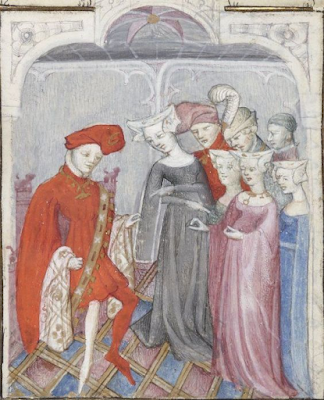
For most of the 14th century, you have the cotehardie with various sleeve treatments and torso tailoring. Various Hanging sleeves were popular in the mid-14th century. Tippets in the later half, and wide hanging sleeves and bombard sleeves became popular in the 1390's. By 1420 cotehardies had been replaced by houppelandes.


The Sideless surcotte is also widely popular, but by 1400 became largely ceremonial.


Houppelandes seem to have developed from academic robes and saw a rise in popularity in the 1390s and by 1420 have completely replaced cotehardies. The also have a variety of sleeve treatments. men have a variety of lengths too.


Hose!

There are very few examples of women’s hose, But we know they were a standard garment for everyday wear as depicted by the art of the time period. There are several examples that show women with knee-length colored hose that are tied around the knee.


Here is an image of an extent pair,

Image from https://www.greydragon.org/library/underwear3.html

Most of the surviving examples of hose are wool, and cut on the bias, which makes sense since wool absorbs body secretions and mitigates odors, and has the stretch needed for fitting a curvy body.


Shoes- 

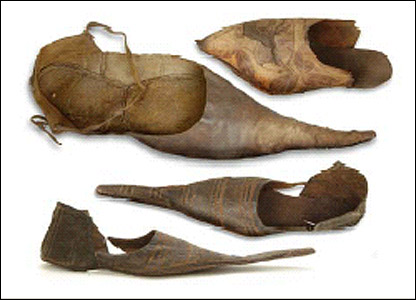
A selection of late 14th-century shoes. Showing decorations and pointed toes. From Museum of London.

Shoes in this age for women tended to be low leather turn shoes. They generally had a pointed toe, that at times could reach extravagant lengths that would peak out from under the long hems. In my experience, the long toes actually help hold the long hem in front of you instead of getting trapped under your feet as you walk.  I suggest you take a look at the Museum of London's medieval shoe collection.  


The Cloak or Mantle-


Cloaks and mantles were often used as a garment to add warmth they also showed wealth, and became a formal garment for court and ceremony. Often made of the same fabrics as the surcotte and lined with fur. As the century progressed the houppelande would overtake the use of the mantle as a fashion garment.

Please note that a coat like garments and hoods have been worn throughout the medieval period in one form or another for practical reasons, are are not the main topic of discussion.


Head covering-

A medieval Lady's outfit wouldn't be complete without a head covering. A young unmarried lady might go about with her head dressed in braids, especially if she were from the South. 

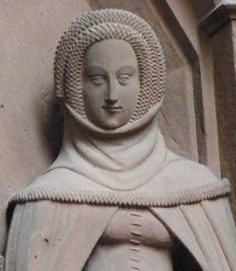
But most women throughout the 14th century wore some type of veil. Sometimes simple, sometimes with bits that cover your chin. beading seemed to be popular in the inventories. Frilled veils seemed to be popular in parts of England and Germany during the mid-14th century. 


Hoods were also a popular choice for the middle class and people doing outdoor activities. 


Towards the end of the 14th century especially in France and England hats started to become very complex. Rolls, cauls, and heart-shaped reticulated headdresses became vogue. 


Well Anyways, I hope this overview is helpful! 
I'll have more detailed notes about specific fashion garments in future posts.
In the meantime, you can also check out my Documentation page, for more info.

Bisous!

~Isabelle~